Have you started browsing engagement rings and found prices that run from a couple of thousand dollars to the cost of a small car? Two rings that look almost the same across a dinner table can sit $10,000 apart, and the price tag rarely tells you why.
The average Australian spent $6,842 on an engagement ring in 2026, according to Easy Weddings’ annual Australian Wedding Industry Report, up 14.5% on the year before. That figure only tells part of the story, though. Natural diamond prices have fallen sharply since their 2022 peak, lab-grown diamonds now cost a fraction of what they did a few years ago, and the same budget can buy two very different rings depending on where the money goes.
Read on for indicative engagement ring prices by carat weight, what each budget buys in natural and lab grown diamonds, how much the setting adds, and the trade-offs that stretch your money furthest without anyone noticing on the finger.

Average Engagement Ring Cost in Australia in 2026
The average engagement ring cost in Australia is $6,842, based on Easy Weddings’ 2026 survey of more than 4,000 engaged and recently married couples. Most couples spend somewhere between $3,000 and $15,000, and a smaller group spends well beyond that.
An average is pulled upward by a handful of very expensive rings, so many couples spend less than the headline figure. It also blends natural and lab grown diamonds together, even though the two now sit at very different price points. For that reason, it’s more useful to look at what each budget actually buys.
What Each Budget Buys
Your budget decides two things above all: whether the centre stone is natural or lab grown, and how large it can be. This table shows what to expect at each level for a well-made ring in 18ct gold.
| Budget | Natural diamond | Lab grown diamond |
Under $3,000 | A centre stone around 0.30 to 0.40ct, or a coloured gemstone | A centre stone around 1ct |
$3,000 to $6,000 | Around 0.50 to 0.70ct | 1.5 to 2ct, or a 1ct with a halo or diamond band |
$6,000 to $10,000 | Around 0.90 to 1ct with good cut, colour and clarity | 2 to 3ct, or a highly detailed custom design |
| $10,000 to $20,000 | 1 to 1.5ct of high quality, or a 1ct with a halo or pavé band | Above 3ct, or premium colour and clarity |
$20,000 and above | 2ct and up, rarer shapes, or exceptional colour | Rarely needed at this level |
Engagement Ring Prices by Carat Weight
Carat weight moves the price faster than any other factor, because larger diamonds are rarer and the price per carat climbs as the stone gets bigger. A 2 carat natural diamond usually costs far more than two 1 carat stones of the same quality.
The ranges below are indicative prices for a well-cut loose diamond in the G to H colour and VS to SI clarity range, before the setting. Prices shift with the market and with every grade, so treat them as a starting point.
| Carat weight | Natural diamond (loose) | Lab grown diamond (loose) |
0.50ct | $1,500 to $3,500 | $400 to $900 |
1ct | $5,000 to $12,000 | $800 to $2,000 |
| 2ct | $18,000 to $40,000 | $1,500 to $4,000 |
| 3ct | $40,000 to $90,000 and up | $2,500 to $7,000 |
1 Carat Diamond Price in Australia
A 1 carat natural diamond typically costs between $5,000 and $12,000 in Australia, depending on cut, colour and clarity. The same weight in lab grown costs around $800 to $2,000. One carat remains the most requested size for engagement rings, and it carries a price jump, so a stone of 0.90 to 0.95ct often costs noticeably less while looking almost identical.
2 Carat Diamond Price in Australia
A 2 carat natural diamond usually sits between $18,000 and $40,000. At this size, small changes in colour and clarity create large price differences, and an excellent cut matters more because flaws and tint are easier to see in a bigger stone. A 2 carat lab grown diamond is commonly $1,500 to $4,000.
3 Carat Diamond Ring Price in Australia
A 3 carat natural diamond ring often starts around $40,000 and can exceed $90,000 for top colour and clarity. Natural stones this size are genuinely rare, which is why prices at the top end have held up better than smaller diamonds. A 3 carat lab grown diamond, by contrast, often costs less than a 0.50ct natural stone.

Natural vs Lab Grown Diamond Prices
The biggest change to engagement ring prices in recent years is the gap between natural and lab grown diamonds. Both are real diamonds, with the same crystal structure, hardness and sparkle, but they now sit in very different price brackets.
Natural diamond prices have dropped by around half since their post-pandemic peak, as lab grown stones have taken a larger share of engagement ring sales. Smaller and mid-range natural diamonds have been hit hardest, while larger, high-quality natural stones have held their value better. Lab grown diamonds have fallen even further, and typically cost 70% to 90% less than a natural diamond of the same size and grade.
Natural diamond | Lab grown diamond |
Higher, and steadier for larger stones | 70% to 90% less for the same size and grade |
Formed over billions of years; finite supply | Grown in weeks; supply keeps increasing |
| Holds some value, especially larger stones | Very little resale value |
| Heirloom pieces and buyers who value rarity | Maximum size and quality for the budget |
Neither is the wrong choice. If rarity and long-term value matter to you, natural is the stronger option. If you want the largest, brightest stone your budget allows, lab grown goes much further.
What Drives the Cost of an Engagement Ring
The centre diamond usually makes up most of an engagement ring’s price, but it isn’t the only factor. These are the decisions that move the total up or down, and how much each one matters.
Factor | Effect on price | Where to save |
Carat | The biggest driver; price per carat rises with size | Choose a weight just under 1ct, 1.5ct or 2ct |
| Cut | A top cut costs more but makes the stone brighter and look larger | Don’t save here |
Colour | Each grade from D down to Z lowers the price | G to H looks white to most eyes; I to J suits yellow gold |
Clarity | Flawless stones carry a large premium | VS1 to SI1 is usually clean to the naked eye |
Shape | Round brilliants cost the most per carat | Oval, cushion and pear cost less and can look larger |
Metal | Platinum costs more than 18ct gold | 18ct gold gives a similar look for less |
| Setting | Halos, pavé and hand detail add cost | A solitaire costs least |
Custom vs ready made | Custom design adds time and craft | Adapt an existing design instead of starting from scratch |
Should You Prioritise Cut or Carat?
Cut, almost every time. Cut decides how much light a diamond returns, so a well-cut 0.90ct stone can look brighter and even larger than a poorly cut 1ct stone. Choose the best cut grade you can afford first, then find the largest carat weight that fits the rest of your budget.
How Much Does an Engagement Ring Setting Cost?
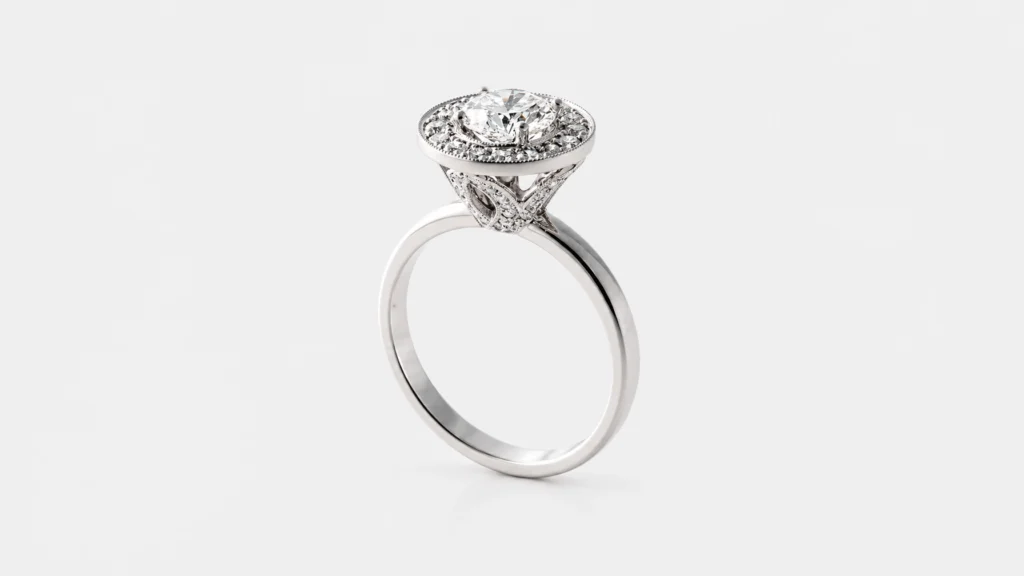
The setting is everything except the centre stone: the band, the claws and any accent diamonds. Its cost depends on the metal, how many small diamonds it holds, and whether it’s handmade or mass produced.
| Setting style | Indicative cost in 18ct gold | What adds to it |
| Plain solitaire | $1,500 to $3,000 | Platinum, a wider band |
Solitaire with diamond band | $2,500 to $5,000 | More or larger accent diamonds |
| Halo | $3,000 to $6,000 | Double halos, pavé shoulders |
| Three stone | $2,000 to $4,500, plus the side stones | Larger or matched side stones |
| Custom design | From $3,000 | Hand engraving, unusual shapes, complex construction |
A handmade setting usually costs more than a cast one, but it uses denser metal that holds stones more securely and is easier to repair later. Our guide to engagement ring setting types compares each style in detail.
How to Get More Ring for Your Budget
A few smart choices can make a ring look like it cost far more than it did. None of these compromise how the ring looks on the hand. They simply move money away from details nobody can see.
- Buy just under the round number. A 0.90ct diamond looks almost identical to a 1ct stone and can cost hundreds or even thousands less.
- Choose eye-clean clarity. VS2 or SI1 diamonds usually show no visible inclusions without magnification.
- Drop a colour grade in yellow or rose gold. Warm metals mask a hint of colour, so an I or J diamond can look just as good as a G.
- Pick an elongated shape. Ovals, pears and marquise diamonds spread their weight across more of the finger than a round of the same carat.
- Add a halo. A ring of small diamonds makes the centre stone look a size or two larger for far less than upgrading the stone.
- Consider lab grown for size. If a large stone matters most, lab grown buys several times the carat weight of natural for the same money.
- Use 18ct gold over platinum. White gold gives a similar look at a lower price.

How Much Should You Spend on an Engagement Ring?
There’s no correct amount. The old rule of two or three months’ salary was a marketing idea, not a tradition, and most couples now set a figure based on savings, other goals and what feels comfortable. Our guide on how much you should really spend on an engagement ring in 2026 walks through how to set a budget that works for you.
Engagement Rings in Adelaide at Every Budget
Get the most from your budget with an engagement ring designed and made in our Burnside studio, where we’ll show you natural and lab grown diamonds side by side and explain exactly where your money goes. DDS Diamond Design Studios has made engagement rings in Adelaide for more than 65 years, founded by Swiss master jeweller Bruno Moser and now in its second generation, and won the 2024 South Australian Bridal Industry Association Award for Best Ring Manufacturer.
Because every ring is made in-house, we can adjust the design, metal and stone to fit your figure rather than forcing you to choose from fixed price points. Every centre diamond comes with its grading certificate, and our finance options can help spread the cost.
Visit us at 46 High St, Burnside, Tuesday to Friday 9am to 6pm or Saturday 9:30am to 2pm. Call (08) 8332 0707 or book a consultation.
Frequently Asked Questions
Quick answers to the questions Australians ask most about engagement ring prices, from average costs to what a 1 carat diamond is worth.
How much should an engagement ring cost in 2026?
The average engagement ring in Australia cost $6,842 in 2026, according to Easy Weddings. Most couples spend between $3,000 and $15,000, depending on whether they choose a natural or lab grown diamond and how large the centre stone is.
What is the average engagement ring price in Australia?
$6,842, based on Easy Weddings’ 2026 survey of more than 4,000 couples. That figure rose 14.5% on the previous year.
How much is a 1 carat diamond ring in Australia?
A 1 carat natural diamond typically costs $5,000 to $12,000 before the setting, depending on its grades. A 1 carat lab grown diamond costs around $800 to $2,000. A setting in 18ct gold usually adds $1,500 or more.
How much does a 2 carat diamond cost in Australia?
A 2 carat natural diamond usually costs between $18,000 and $40,000. A 2 carat lab grown diamond is commonly $1,500 to $4,000.
How much is a 3 carat diamond ring in Australia?
A 3 carat natural diamond ring often starts around $40,000 and can exceed $90,000 for top grades. A 3 carat lab grown diamond typically costs $2,500 to $7,000 before the setting.
Are lab grown diamonds cheaper than natural diamonds?
Yes, by a wide margin. Lab grown diamonds typically cost 70% to 90% less than natural diamonds of the same size and grade, though they hold very little resale value.
How much does an engagement ring setting cost?
A plain solitaire setting in 18ct gold usually costs $1,500 to $3,000. Halos, diamond bands, platinum and custom designs add to that.
What is the cost of a gemstone engagement ring?
Sapphire, ruby and emerald engagement rings vary widely, often from around $2,000 to $10,000, depending on the stone’s size, colour and origin, and the setting.
Should I prioritise cut or carat in an engagement ring?
Cut. A well-cut diamond returns more light, so it looks brighter and often larger than a poorly cut stone of greater weight.
Which hand is the engagement ring worn on in Australia?
The left ring finger. Many people move it to sit alongside their wedding band after marriage, and some wear it on the right hand.