
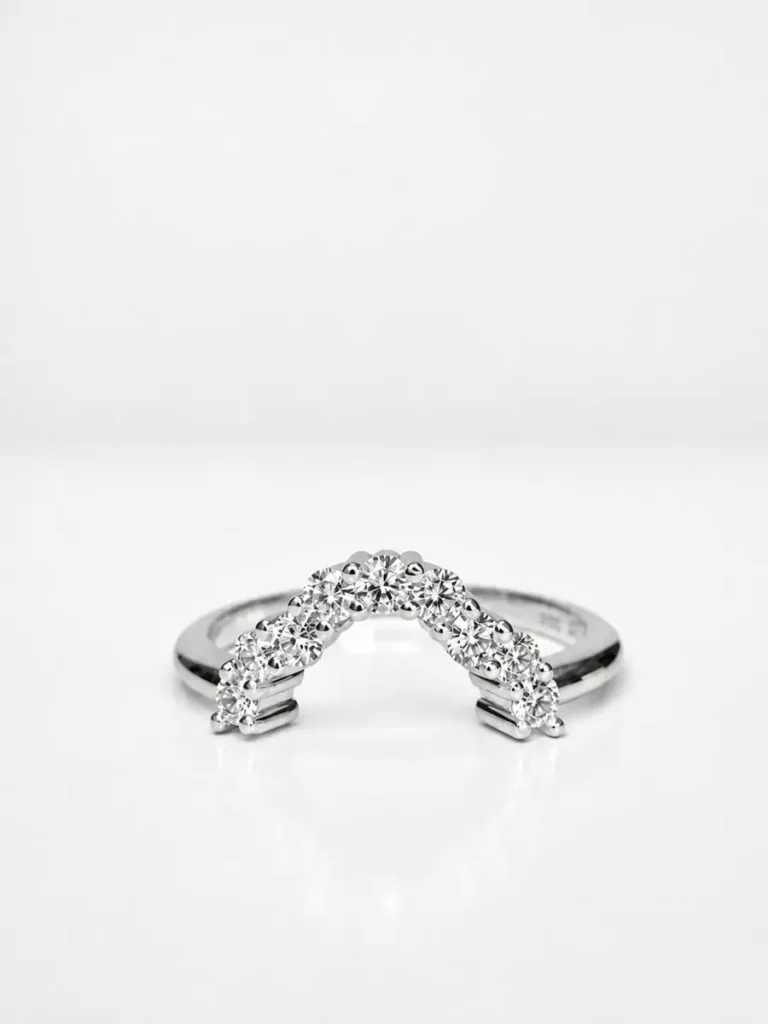
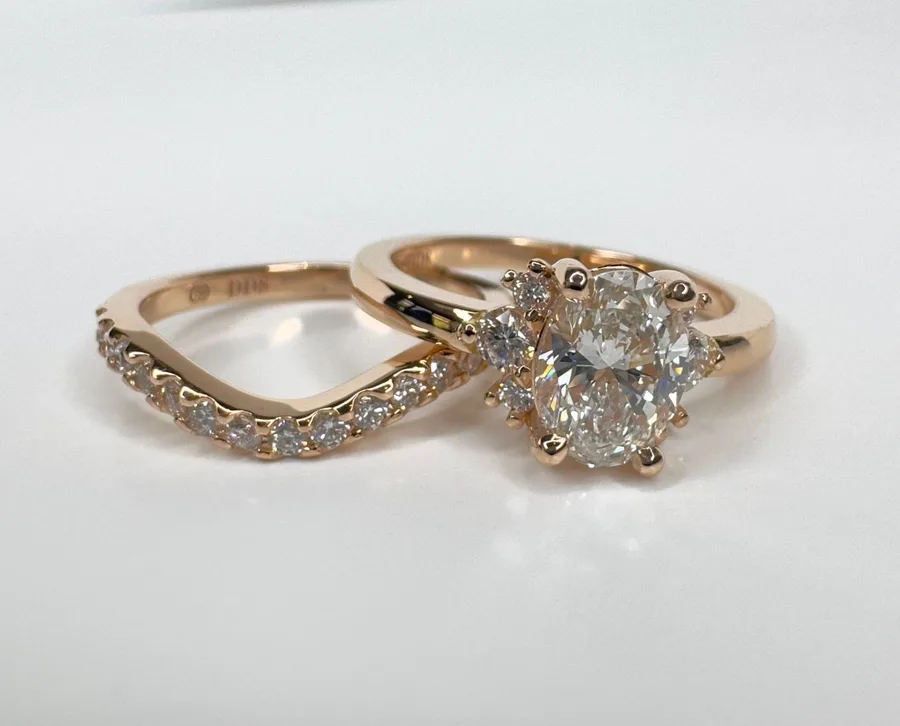
A fitted wedding band is shaped to follow the outline of your engagement ring, so the two sit together without a gap. Where a straight band leaves a wedge of daylight beneath a raised setting, a fitted band curves to meet it.
We make them in our studio at 46 High Street, Burnside, and it is one of the more useful things we do — because a band that fits properly looks like a set, rather than two rings that happen to be next to each other.
What “fitted” actually means
Most engagement rings sit high enough that a straight band will not touch them along their whole length. There is a gap at the centre, and it is the first thing people notice once the second ring is on.
That is why the height of the setting matters. If you want a straight band to pass underneath the setting, the centre stone has to be raised enough to leave room for it — though even then, the band can sometimes still catch the setting as it passes.
A fitted band solves it differently. It is not a straight band trying to pass beneath the setting; it is shaped to follow the whole outline of your engagement ring, all the way around, so it nestles against the ring it was made for. The curve is cut and carved to your ring rather than bent cold, which is why it follows the actual contours of your setting rather than an approximation of them.
The three profiles we make
Almost every fitted band falls into one of three shapes, and which one you need is decided by the ring you already own, not by preference.
- A shallow curve for a low setting that sits close to the finger.
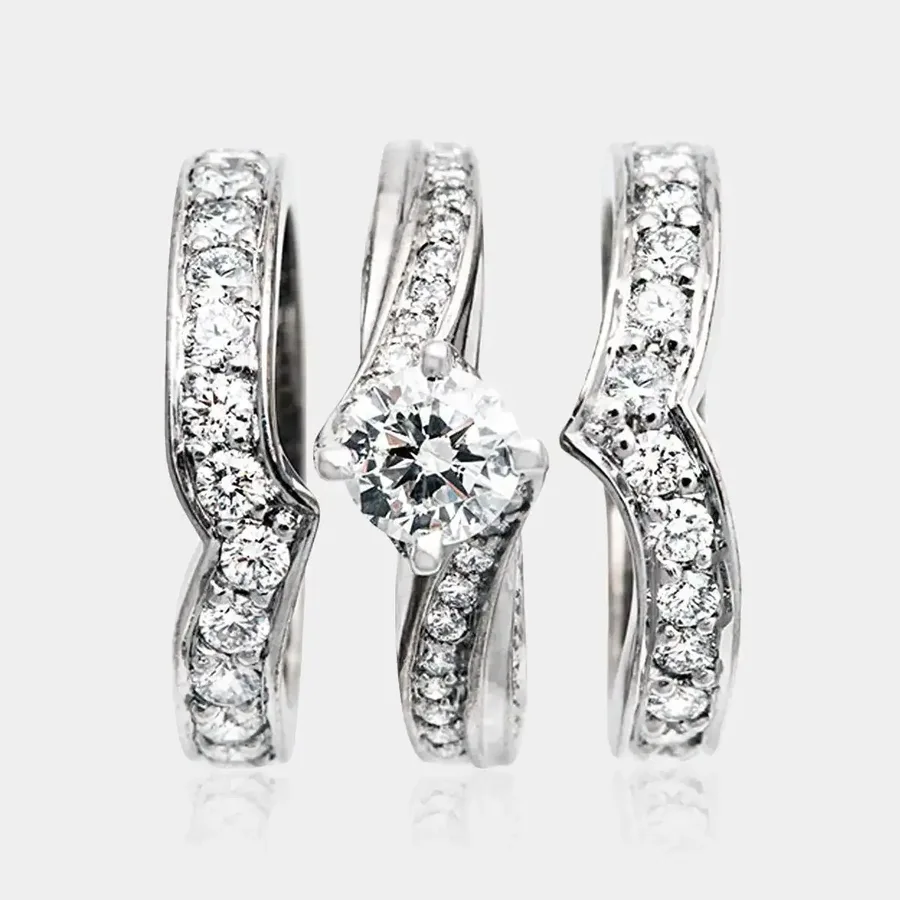
- A deeper scoop for a halo, a raised shoulder, or a cluster that sits proud of the band.
- A notch for a ring with a wide basket, where the outline the band has to follow is deeper and more angular.
If you are not sure which yours needs, that is what the fitting is for.
Comfort fit, and who it suits
Comfort fit is a separate decision, and people often confuse the two. Fitted describes the outside of the band, where it meets your engagement ring. Comfort fit describes the inside.
A comfort-fit band is domed on the inner surface, so only a narrow strip of metal touches the finger. It feels smoother, slides on and off more easily, and it is generally a better choice for a wider band than for a narrow one.
It is not always the right answer. If you expect to resize the band more than once over the years, a flatter inner profile gives us more room to work with.
Which metal to choose
The band does not have to match the engagement ring, but it should not fight it. Yellow gold beside white gold reads as deliberate; yellow gold beside platinum can look like a mistake unless the two are chosen together on purpose.
White gold needs rhodium plating to keep its colour, and it will need re-plating every year or two with regular wear. On a ring we made that is $60, and $90 on a ring we did not, for the life of the ring.
Platinum wears to a duller finish and can be polished back instead. Both are in use in the studio daily, and we will tell you honestly which suits your ring and your habits.
The metal and the width of a fitted band are guided by the engagement ring rather than chosen in isolation. The band should carry roughly the same weight and width as the ring it sits against, in the same material, or the pair looks mismatched from across a room — and a heavier band beside a light one will wear the light one away.
Because the profile has to be cut to fit an existing ring exactly, a fitted band is more difficult to get right than a straight one, and it takes more time. That is the honest reason it costs more than a plain band of the same weight.
As a guide, most fitted wedding bands fall between $1,000 and $4,000, depending on the gold you choose and the size of the diamonds or gemstones set into it. A plain band in a lighter gold sits at the bottom of that range; a full diamond band in platinum sits at the top.
What happens if the engagement ring is resized later
This is worth thinking about before anything is made, because it is the most common thing that goes wrong. If the engagement ring is resized after the band is fitted, the pair can stop sitting together properly, and the band may need adjusting to suit.
Where we can, we size the engagement ring first and cut the band afterwards. If your ring is likely to need resizing — a winter finger, a ring bought before a pregnancy — tell us at the fitting and we will plan around it.
The fitting, and how long it takes
The engagement ring has to be with us. We shape the band against the actual ring rather than against a measurement on paper, because two rings that look identical flat can sit differently once the curve is cut.
Allow thirty minutes to an hour for the fitting. After that, the band takes four to six weeks to make. Book a fitting and bring the ring with you.
Within the $1,000 to $4,000 range above, the exact price is set by the metal and the stones you choose — which is why we do not give a final figure before we know both. Tell us the metal and whether you want stones, and you will have a number the same week.
Bring the ring in
Come in with the engagement ring and we will draw the profile against it before anything is made. You will see how the two will sit together before you commit to a metal. The consultation is free and there is no obligation — book an appointment with our studio in Burnside.